F1 Race Strategy Decision Support
Lap-time prediction and Monte Carlo simulation for comparing pit-stop strategies using real 2021–2025 F1 data.
- 1.41s
- HGB MAE
- 2,000
- Monte Carlo runs
- 2021–25
- Race data
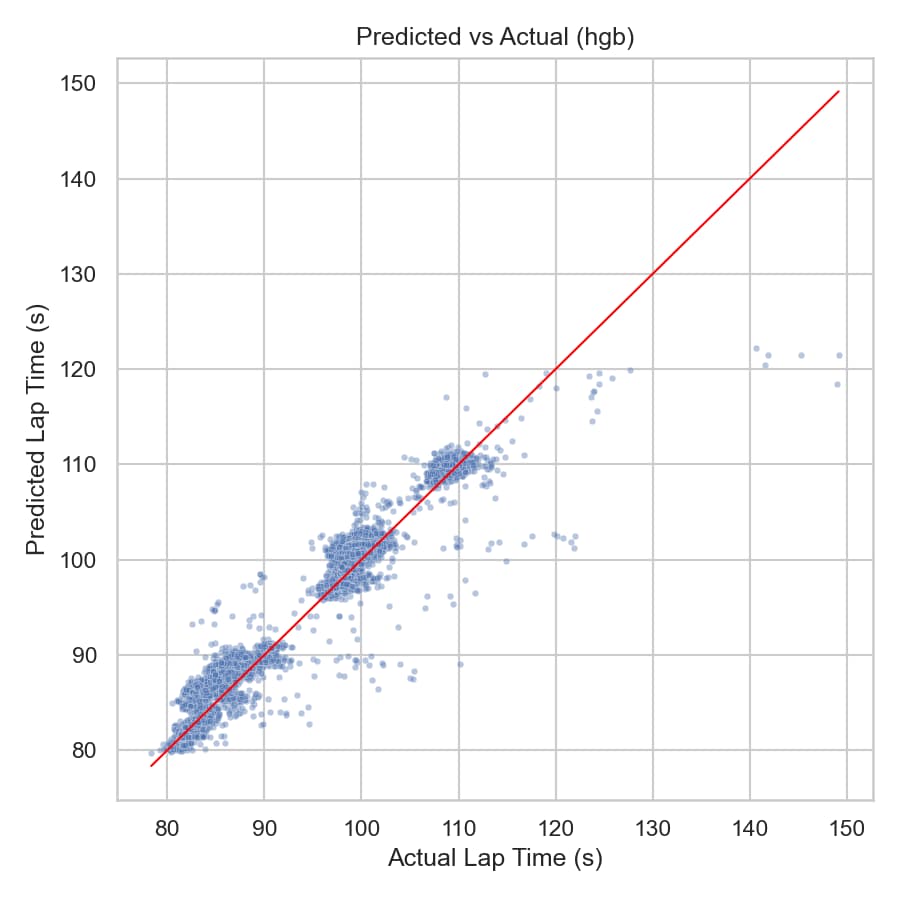
On the held-out rounds, the predicted race-normalized lap-time delta differs from the observed delta by roughly 1.41 seconds on average. This is a lap-time error, not a measure of race-outcome accuracy.
What I was trying to solve.
Race strategy couples tyre degradation, pit loss, weather, and uncertainty. Manually reasoning over every combination is impractical, so the system makes the trade-offs explorable.
Inspect original evaluation chart ↗
Follow the data.
A simplified processing flow. Each numbered stage feeds the next; storage and retrieval boundaries stay explicit.
- FastF1 telemetry
- Feature engineering
- Rolling split
- Lap-time model
- Monte Carlo simulation
- Strategy bands
- Interactive dashboard
The constraints shaped the system.
Predict race-normalized lap delta rather than raw lap time, compare Ridge with HistGradientBoosting, and sample residuals plus pit loss to return P10/P50/P90 strategy-time bands instead of a single false-precision answer.
Where the happy path ends.
Wet-weather laps and Las Vegas produce larger errors. The model is more trustworthy in dry-race scenarios and does not yet explicitly simulate traffic, safety cars, or overtakes.
What exists today.
- HistGradientBoosting achieved 1.41s MAE and 2.25s RMSE on rounds 17–24.
- Supports up to 2,000 Monte Carlo simulations per strategy with P10/P50/P90 bands.
- A Belgian GP case study recommended a Medium-to-Hard one-stop comparable to the actual strategy.
Ridge provides the comparison baseline. HistGradientBoosting is evaluated chronologically on rounds 17–24; residual sampling and pit-loss variation produce P10/P50/P90 strategy bands. Those bands describe the simulation assumptions, not every source of race uncertainty.
What I would improve.
Build a dedicated wet-weather model, add traffic, safety-car, and overtake effects, and investigate the Las Vegas residual spike.